Recurring transactions
Rent, salary, subscriptions and loan payments come back on a regular schedule. Set them up once as a recurring transaction and Beyond Budget schedules the next payment for you, so your budget and balance projection always include what's coming.
Make a transaction repeat
-
Create a transaction or open one to edit it.
-
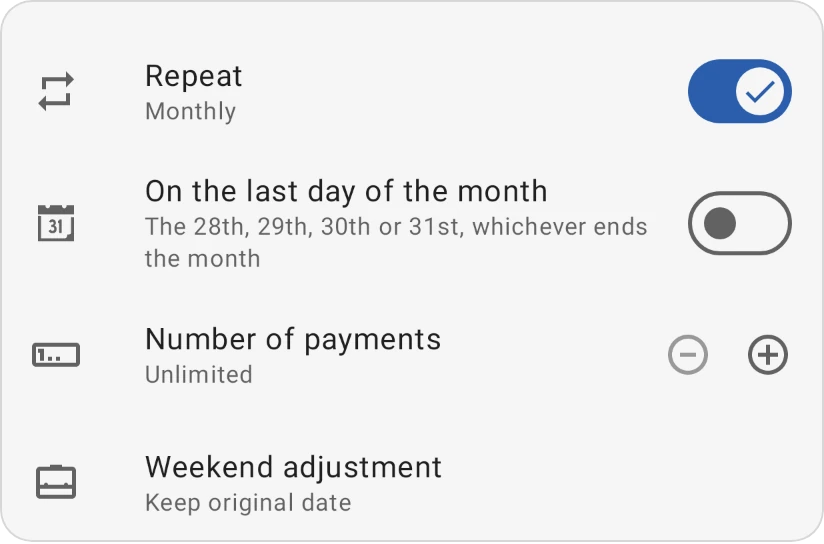
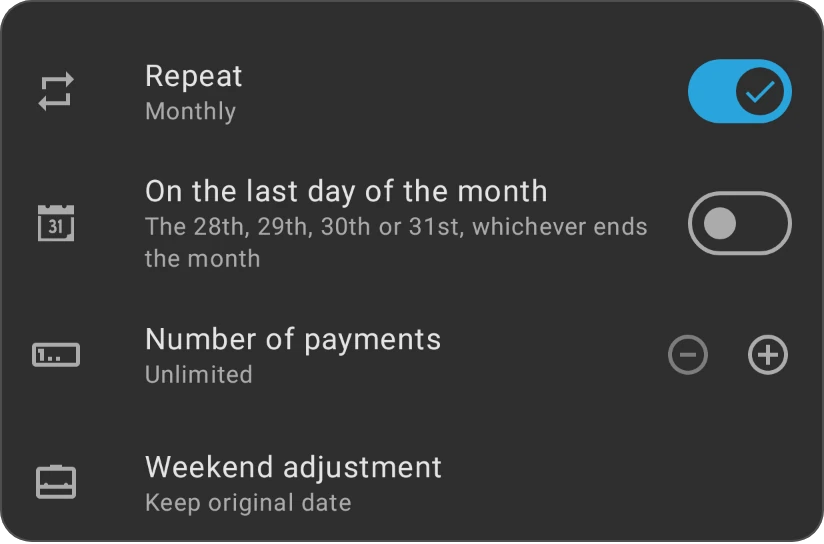
Turn on Repeat and choose how often it happens: Daily, Weekly, Fortnightly, Every 4 weeks, Monthly, Every two months, Quarterly, Every 6 months, Annually or Every 2 Years.
-
For a schedule of a month or longer (Monthly, Every two months, Quarterly, Every 6 months, Annually or Every 2 Years), turn on On the last day of the month if it's due when the month ends, like a salary paid on the last day. See Pay on the last day of the month.
-
Number of payments: leave it on Unlimited, or use − and + to stop after a set number of payments (for example 12 monthly loan payments).
-
Weekend adjustment: what to do when a payment falls on a weekend: Keep original date, Shift to next Monday or Shift to previous Friday.
-
Save the transaction.
To stop a transaction repeating, open it and turn Repeat off.
Pay on the last day of the month
With On the last day of the month on, the payment falls on the 28th, 29th, 30th or 31st, whichever ends the month: 31 January, 28 February (29 in a leap year), 31 March, 30 April and so on. Repeat then shows the frequency with "last day", for example Monthly · last day.
- Turning it on moves the transaction's date to the last day of its month.
- Picking a date that isn't the end of its month turns it off.
- A date on the 31st already means the last day of every month, so the switch shows on and can't be turned off.
- You can turn it on for an existing series too: the upcoming payment moves to the month's end, and so do the ones after it. It can't be changed on a payment that's already recorded.
With Shift to next Monday, a month end on a Saturday or Sunday would move the payment into the next month. A last-day series moves it to the Friday before instead, so every month keeps its payment: Sunday 31 May 2026 is paid on Friday 29 May, not Monday 1 June. If that Friday has already passed, the payment falls on the Monday.
How the schedule works
Only the next payment in the series is saved, and it appears under Upcoming transactions. When its date arrives, it's processed and the following one is scheduled. Further payments are still estimated in views that look ahead, such as the balance projection and the transactions calendar.
To change the whole series (a new category, say), edit the next upcoming payment: the change carries over to the payments after it. An existing series can't be set to fewer payments than it has already made.
See Future for more about upcoming transactions and their reminders.
Change one payment or all the later ones
When you change only the amount or the date of the next upcoming payment, the app asks Which payments change?
-
Open the next upcoming payment and change its amount or its date, in the editor or straight from its details.
-
Save. The app asks Which payments change?
-
Choose:
- Change only this payment: this payment gets the new amount or date; the ones after it keep their usual amount and date. Use it for a bill that's higher once, or a payment that's late this time.
- Change this and later payments: the new amount or date applies to this payment and every one after it, like a rent rise.
Close the question without choosing and nothing is saved.
A payment changed on its own shows a note on its details: "Changed for this payment only. Later payments keep their usual amount and date."
The app doesn't ask, and the change applies to this and later payments, when:
- you also change anything other than the amount and the date (the category, the notes, the schedule);
- it's the last payment of a series with a set Number of payments;
- you move the date to the day of the payment after it, or later;
- you move the date of a Daily payment (changing its amount still asks);
- the payment is due today;
- you process the payment now with Process now.
Each recurring series counts as an upcoming transaction. On the Free plan you can have up to 10 upcoming transactions; Pro raises this to 300.