CSV
Import transactions from a CSV file, such as an export from your bank or another budgeting app. You map the file's columns to the app's fields, review the transactions, fill in anything missing (or let AI do it), and import them in one go.
Start an import
You can start from several places:
- Transactions tab: open the ⋮ menu and choose Import transactions (CSV).
- More › Profile: under Data & Backups, tap Import data.
- More › Support: under Tools & Resources, tap Import data.
- An account's Account details: open the ⋮ menu and choose Import transactions. Every transaction goes into that account, so your file doesn't need an account column. This screen also accepts OFX, QIF and OFC files (see OFX, QIF and OFC).
On the Import transactions via CSV screen:
-
Turn on Swap inflow and outflow if your bank exports deposits and expenses the wrong way round (you can also change this on the next screen).
-
Tap Pick file and choose your CSV file.
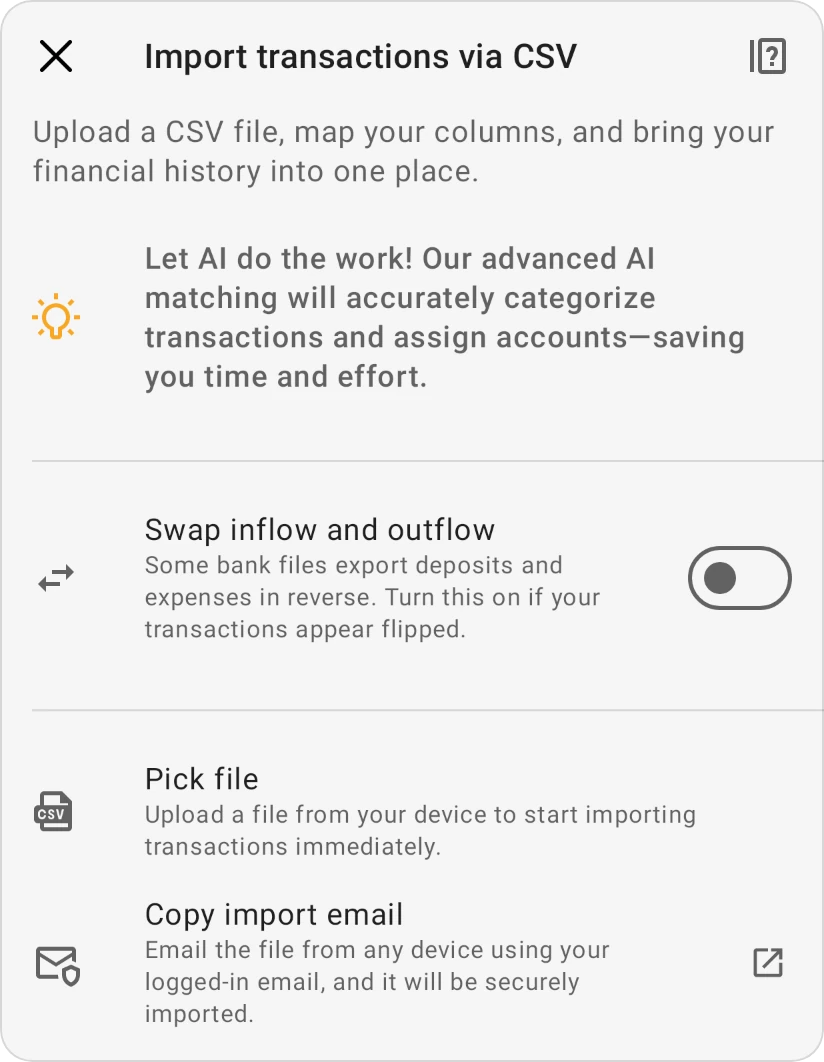
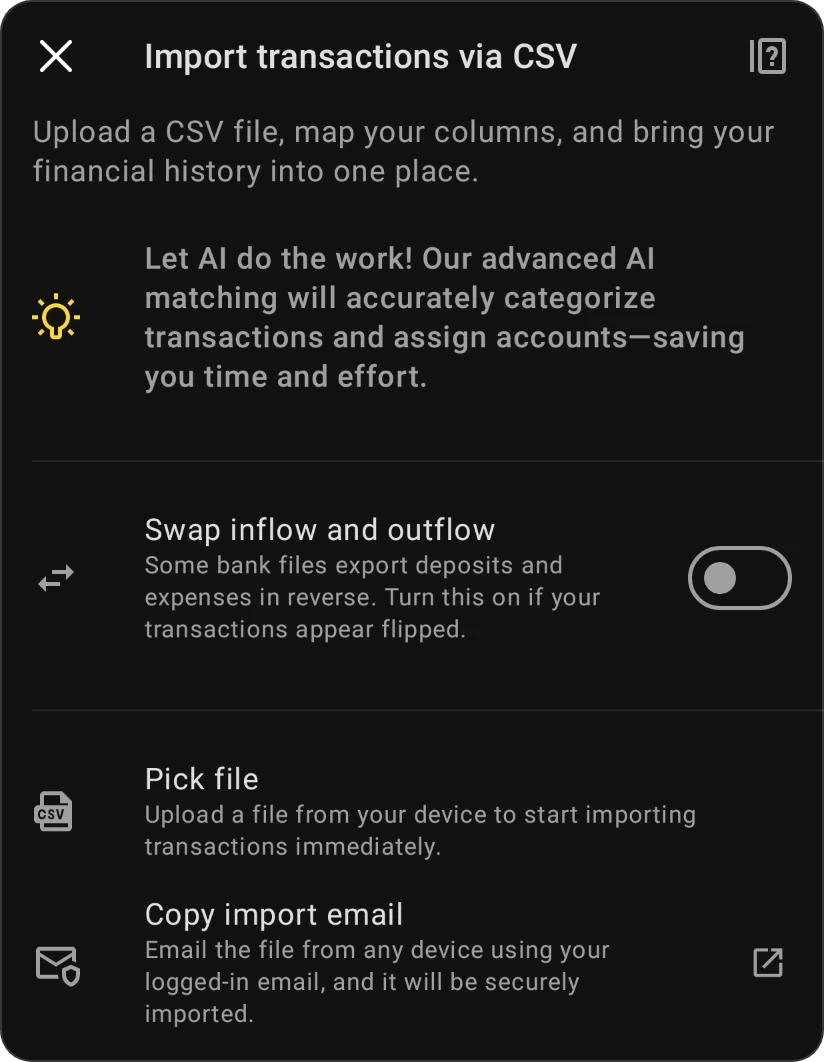
On Android you can also open a CSV or bank file with Beyond Budget from your file manager or email app. The app asks Which account? and then starts the import.
Map your columns
The CSV mapping screen lists each CSV column of your file, what it's Mapped to, and a preview of the first row's value. The header shows how many transactions the file contains.
Common column names (for example Date, Amount, Category, Account, Payee, Notes, Tags) are recognised and mapped automatically. Tap a column to change its mapping. The fields you can map to are:
- Amount (required): positive for money in, negative for money out.
- Income and Expense: for a file with two amount columns, such as Paid in and Paid out or Credit and Debit. Map one to each instead of Amount. Swap inflow and outflow is hidden while they're mapped.
- Date: shows how the app read your dates. Check it, see Check the date format.
- Category
- Account (not offered when you import from an account)
- To Account (For transfers only): the account money was moved to. A transfer also needs the account it came from, either an Account column or the account you started the import from.
- Notes, Payee, Tags
- None: ignore the column.
Tap Next to continue. If you haven't mapped date, amount, category or account, the app asks Proceed with CSV importing? and recommends mapping them so the AI can help on the next step. You can carry on and fill them in by hand instead.
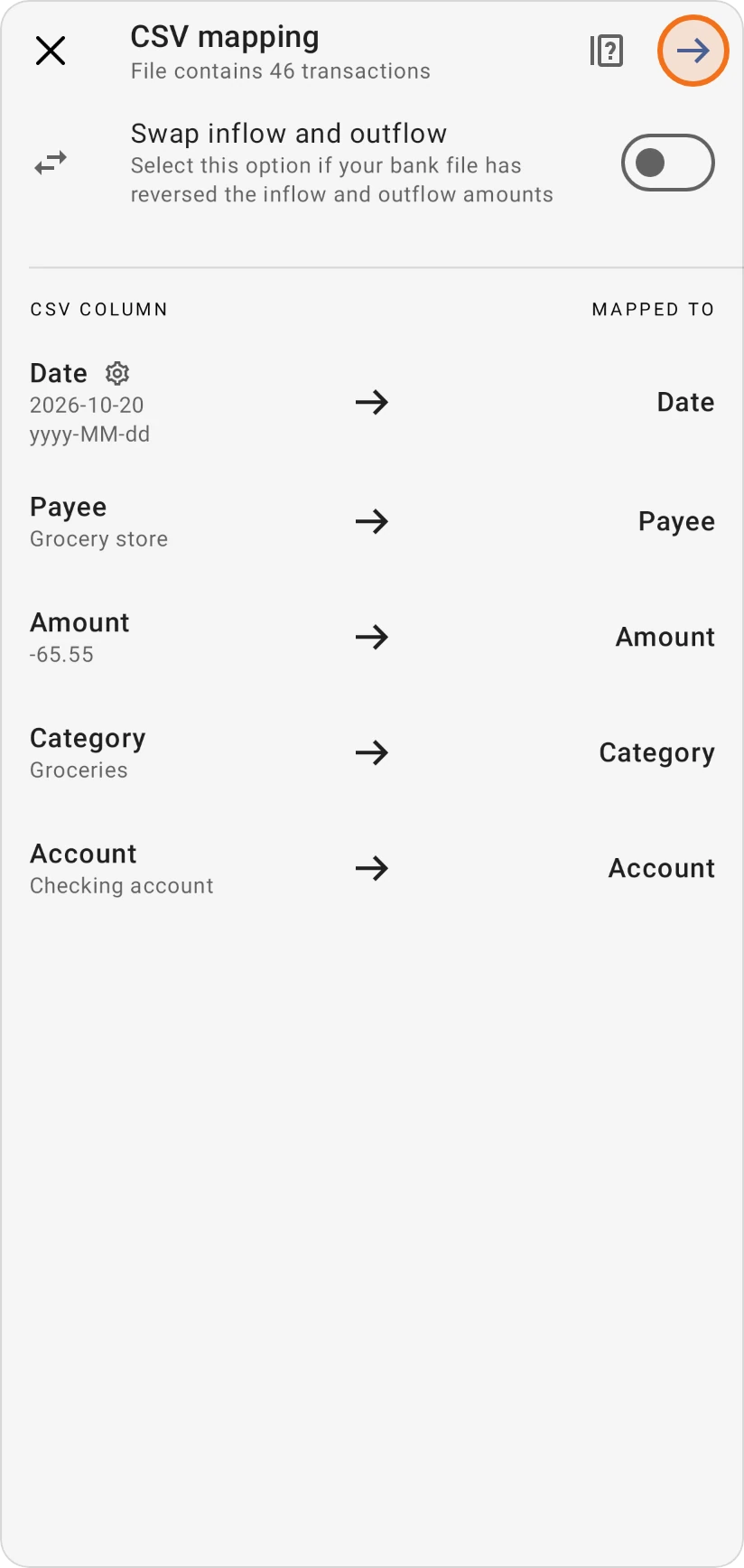
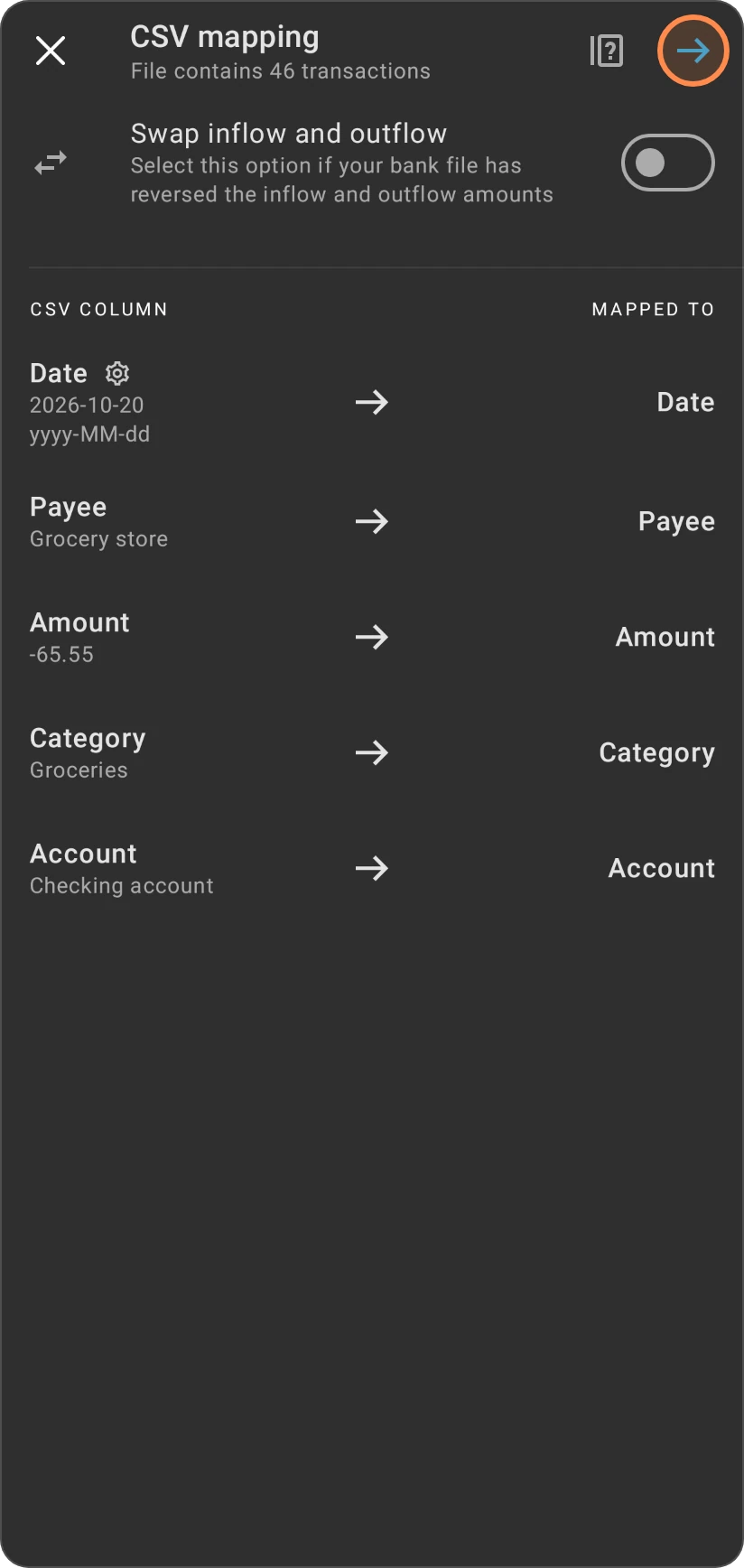
If some rows can't be read, a warning lets you view the CSV Errors with their line numbers; if you continue, those rows are left out.
Check the date format
The app reads every date in the Date column and works out the format from all of them. It understands numbers (03/04/2026, 3.4.2026, 2026-04-03) and written months (30 Mar 2025, 5 März 2026), in any of the app's languages.
Under Date it shows what it found:
- the first date and how it was read, for example 11/15/2026 → Nov 15, 2026;
- the format, for example MM/dd/yyyy;
- how many rows have a date, and the first and last date;
- a line for rows that need your attention: rows that can't be read in this format, rows dated after today, and rows that will be left out (see Free and Pro).
A date like 03/04/2026 can be read two ways: 3 April or March 4. If every date in your file could be either, the app asks How are dates written in this file? and shows some of your dates read each way. Pick the one that matches your bank and tap the checkmark. If you close the question, the app goes by your country: month first in the United States and English-speaking Canada, day first everywhere else.
If the dates under Date look wrong:
-
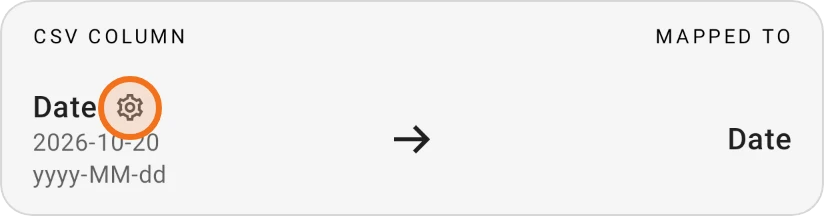
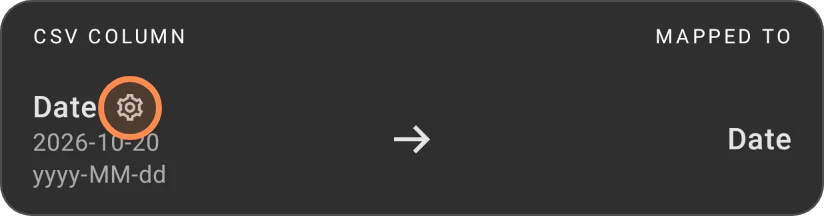
On the CSV mapping screen, tap the settings icon (⚙) next to Date.
-
Under Date format, pick the format your file uses: dd/MM/yyyy (day first), MM/dd/yyyy (month first), yyyy-MM-dd or yyyy-dd-MM.
-
Check the date and the lines under the column again, then tap Next.
The format you pick is used for every row in the file. If nothing can be imported because of the dates, the Review and confirm screen says why, with a Change date format link that takes you back to this choice.
Review and confirm
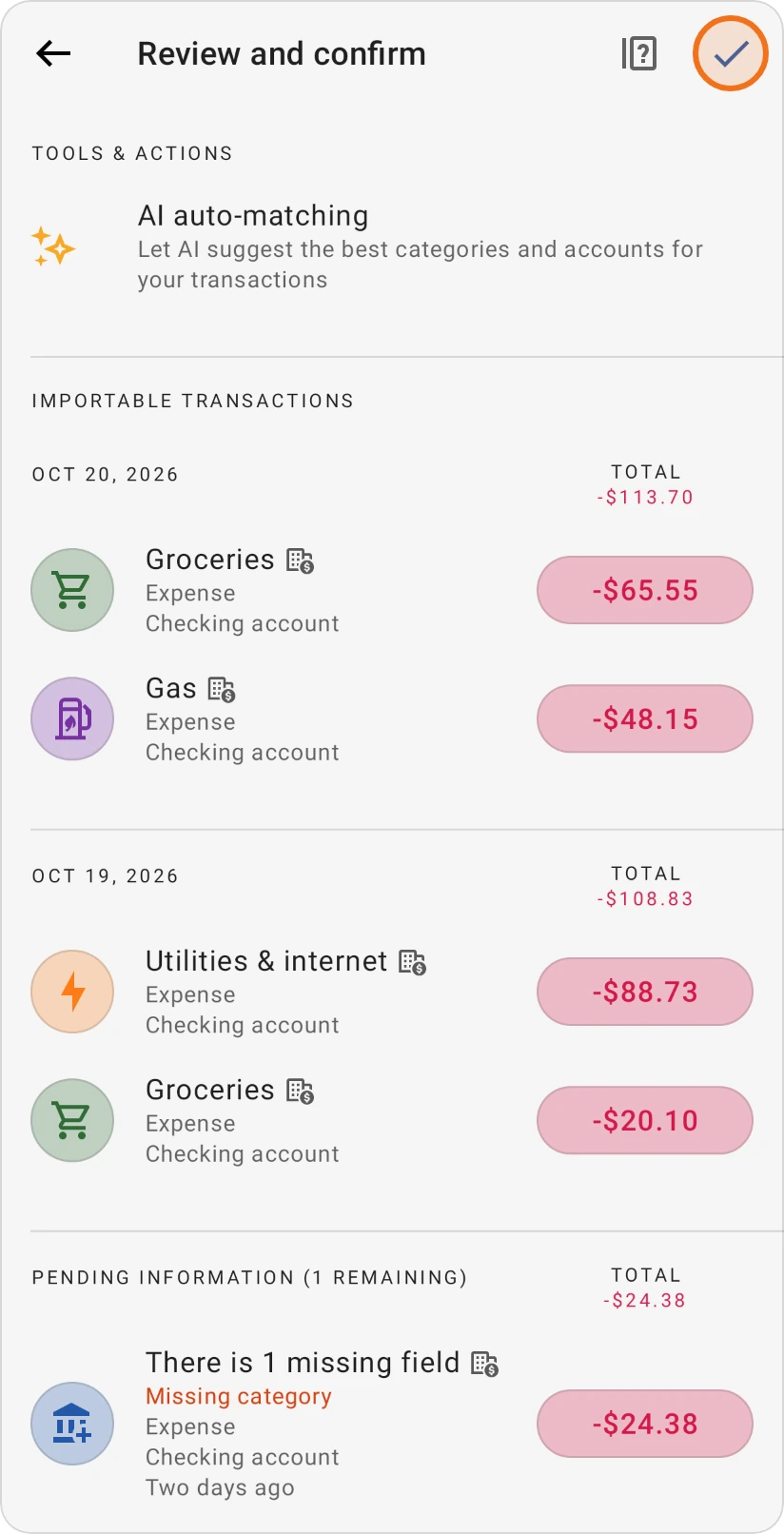
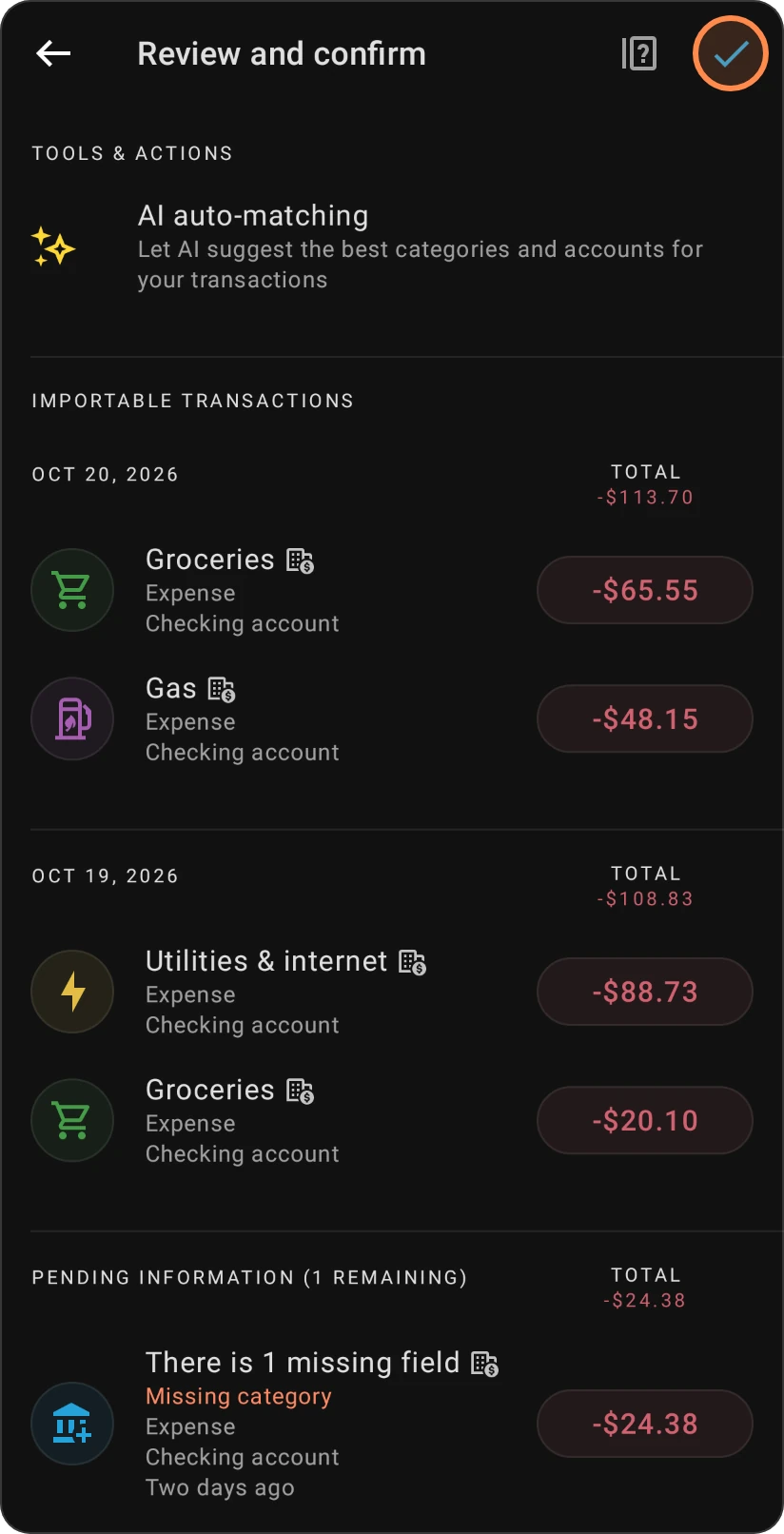
The Review and confirm screen starts with Tools & Actions (see below), then groups the transactions:
- Importable transactions: ready to go, grouped by day.
- Pending information: transactions missing something, such as a category or an account, with how many remain. Each one says what's missing.
- Invalid transactions: rows that can't be imported, for example when the amount isn't a valid number.
Only importable transactions are imported. To fix one that's pending, tap it and pick what's missing. Swipe a transaction to the left to remove it from the import.
Tools & Actions
At the top, Tools & Actions offers quick fixes:
- AI auto-matching (Pro): "Let AI suggest the best categories and accounts for your transactions". The AI matches the category and account names in your file to the categories and accounts in your budget and fills them in on the pending transactions. Check the result, and tap the undo action on the message if you don't like it.
- Bulk edit mappings: "Quickly update categories and accounts for multiple transactions at once". On the Bulk property mapping screen, each value From CSV (for example Groceries) is listed under Categories or Accounts: choose the category or account it should become, and tap Set mapping to apply it to every transaction with that value.
- Remove duplicates: shown when some transactions look like ones you already have, marked Possible duplicate. Removes all of them from the import in one go.
When everything looks right, tap the checkmark at the top. The app confirms how many transactions will be added (and warns you if some look repeated), then tap Import. The transactions are added to your accounts straight away.
Free and Pro
| Free | Pro | |
|---|---|---|
| How far back you can import | 3 months | Up to 5 years |
| Transactions dated after today | Up to 12 months ahead, within your 10 upcoming transactions | Up to 12 months ahead |
| AI auto-matching | — | ✅ |
| New payees and tags from the file | Within the Free limits (5 payees, 5 tags) | ✅ |
Transactions older than your plan allows, more than 12 months ahead, or over the Free plan's upcoming transactions limit (see Future transactions) are left out. A banner on Review and confirm says how many were left out and why. Transactions dated after today are imported as upcoming transactions. Each file can hold up to 500 transactions, so split a bigger file into smaller ones. If the file's new payees and tags would take you over your plan's limits, the transactions are still imported, just without creating those payees and tags.
Send the file by email
On the import screen, tap Copy import email to copy our import address, or the open-email button next to it to start an email. Send the file from the email address you sign in with, from any device, and it's imported securely into your budget. This is handy when the file is on your computer.
For the smoothest import, make sure your file has a header row with column names. If the app says the file is invalid, check that it includes columns for Date, Amount, Category and Account.