Large debts
For a mortgage, car loan or student loan, set up a Loan account. It tracks the balance, interest rate and term, links to a category where you set money aside for each payment, and works with the loan calculator to show how much interest and time extra payments can save you.
For smaller, informal debts (money borrowed from a friend, money you lent), use Debts instead.
Set up a loan account
- Open Accounts and tap New account.
- Enter the Account name, for example Car loan or Mortgage.
- Set Account type to Loan.
- Enter the Loan balance: the amount you still owe.
- Choose the Payment frequency (for example monthly or weekly) and, if your lender uses one, the Compounding frequency.
- Choose the Linked category for your payments, or leave it on Create new category to have the app create one. This is the category where you set money aside for the loan.
- Enter the Annual interest rate.
- Fill in Term remaining or Payment amount / … (per payment period). The two are linked: set one and the app works out the other.
- Confirm.
Once the loan details are filled in, the form shows Pay less interest with extra payments. Enter an Extra payment to see how much interest you'd save and how much sooner you'd be done, with a chart comparing the Original balance and the Balance after extra payments.
Make a payment
- Each month (or pay period), allocate the payment amount to the loan's linked category, so the money is ready when the payment is due.
- Open the loan account and tap Add payment. The row shows how much is available in the linked category.
- Enter the Amount, the account it's paid From and the Date. To pay exactly what the linked category has available, tap Pay balance next to the amount.
- Under Payment breakdown, split it into Principal, Interest and Fees, and check the Projected balance.
- Confirm. The payment comes out of the linked category, so your budget stays in sync.
If the amount is more than what's set aside in the linked category, the app asks you to allocate more to the category first. If the loan has no linked category yet, the account shows a warning with a button to link one.
After each payment the loan's balance and history update, and you can follow your progress on the account.
What interest and fees do
The whole Amount comes out of the loan's linked category and goes into the loan account. When you enter Interest or Fees, the app also records each one as its own expense on the loan, with the note "Loan interest" or "Loan fees". These two expenses:
- have no category, so they don't come out of your budget a second time: the payment you set aside already covers them;
- raise what you owe on the loan by their amount, so the loan's balance only goes down by the Principal (the Amount less interest and fees);
- are marked cleared and can't be edited.
Principal, Interest and Projected balance are linked: change one and the app works out the others. When you first open the payment, Interest is filled in from the loan's Annual interest rate for one payment period, and you can change it to match your lender's statement.
You can Adjust balance on a loan account at any time without affecting the rest of your budget. It's handy for corrections, for example to match the balance your lender reports.
You can also change the loan's Annual interest rate, Term remaining, Payment frequency and Compounding later from the account's details.
Loan calculator
The loan calculator shows how a loan is paid off and what extra payments would change. Open it from:
- The side menu: Loans (under Debt calculators). This opens an empty calculator for any loan you're thinking about.
- A loan account: ⋮ › Debt calculator, filled in with the account's details.
- A debt in Debts: the Debt calculator button, filled in with the debt's balance and due date.
Enter the Loan details: the Amount, Payment frequency, Annual interest rate, and either Term remaining or Payment amount / …. Then try different amounts in What if I add an extra payment? and choose how the extra is paid:
- Every payment: added to each payment. The extra goes on top of every regular payment, so it can be at most the balance less the payment.
- One time: paid once, off the balance, for example a bonus or a tax refund. Under When, keep Now or pick a later month, up to the month before the loan's last payment. A one-time extra can be as large as the whole balance.
Each choice keeps its own amount, so you can switch between them to compare. The app shows:
- How much you'd save in interest and how much shorter the term would be.
- The Payoff date, Total interest and Total to be paid, with and without the extra payment.
- A chart comparing the Original balance with the Balance after extra payments.
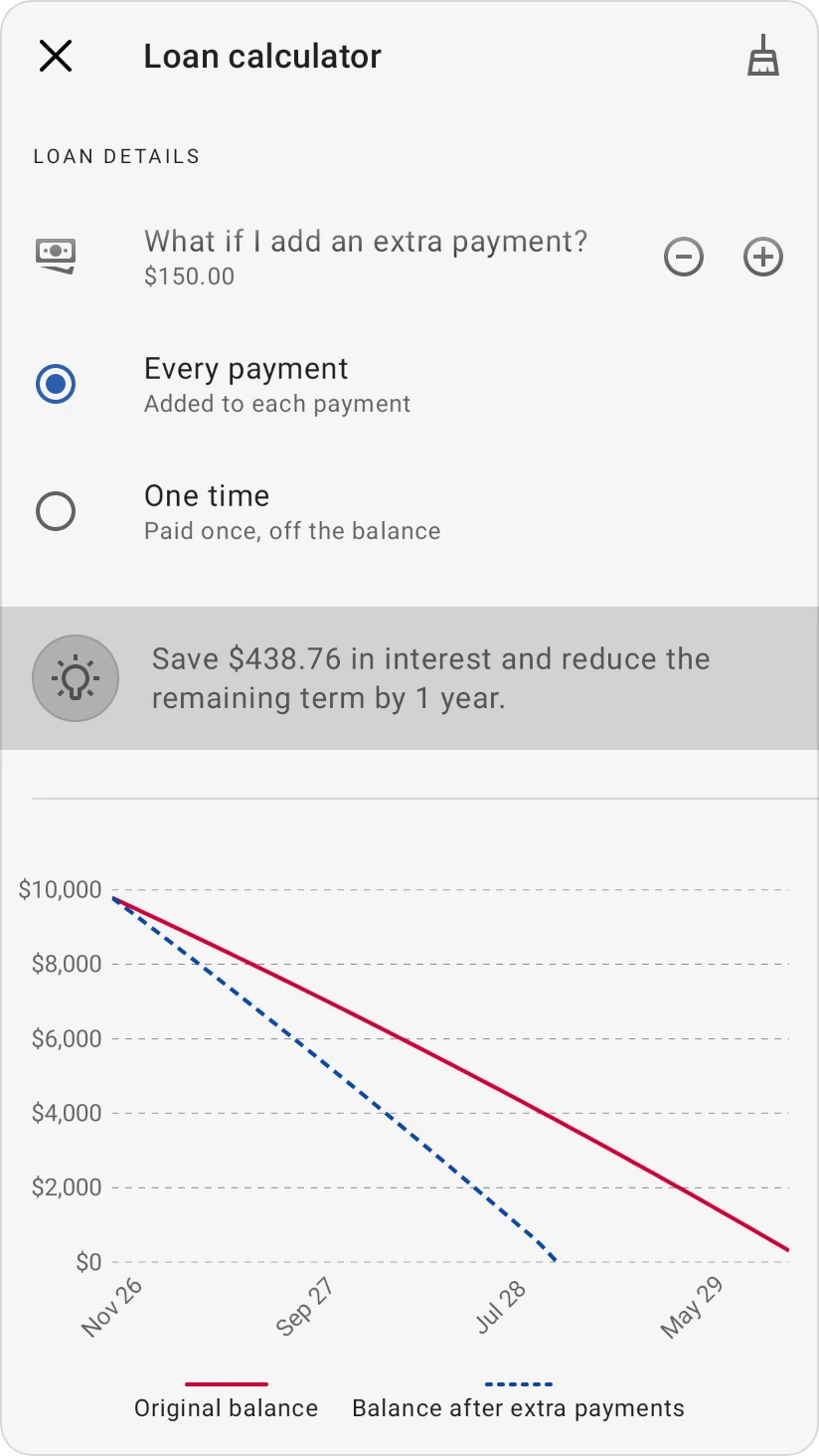
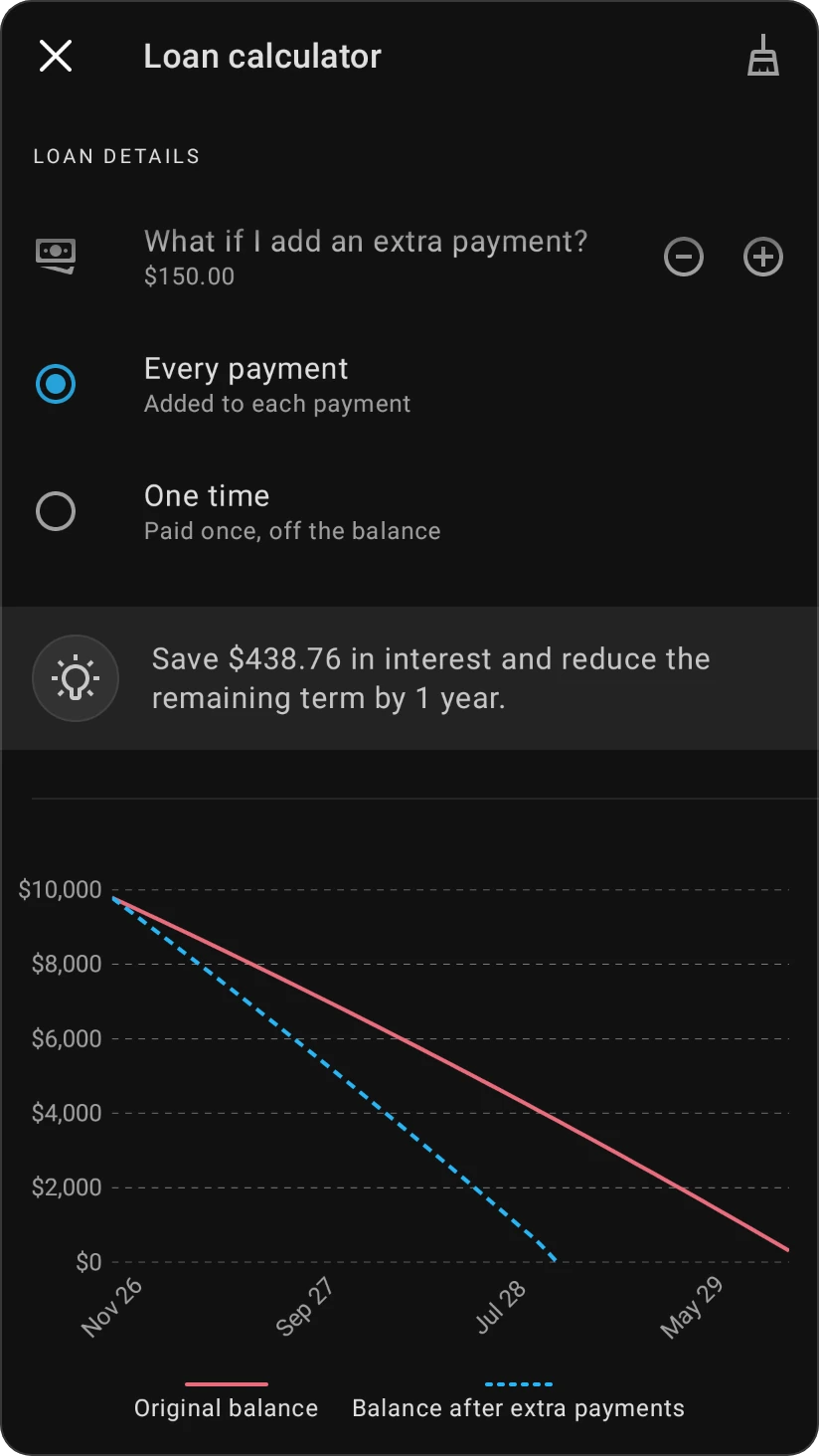
The calculator you open from the side menu remembers your last plan, including the extra payment, whether it's on every payment or one time, and the month of a one-time extra. If that month has passed, it opens on Now. Clearing the calculator goes back to Every payment.
If the payment is too low to pay off the balance and interest in a reasonable time, the calculator tells you.
The calculator is a reference. Real amounts and dates can differ by lender because of rounding, fees and other factors. It assumes a loan that pays itself off with regular payments.
Make repayment a target
The loan's linked category can have a target, so you always set aside enough for the next payment. When you open the debt calculator from the target of a loan's linked category, you can tap Set as target to use the calculated payment, with or without your extra payment, as the target. A One time extra isn't part of each payment, so with it only the payment without the extra can be set as the target.
Using bonuses or tax refunds for occasional extra payments can make a real dent in your loan. Check the calculator to see how much each one saves.